A lab reference for proper handling, preparation, and storage of research peptides.
Safe Handling & Reconstitution Reference
A Research-Grade Guide by Helix Havoc Labs
At Helix Havoc Labs, our focus goes beyond sourcing and testing. We are committed to ensuring that every product is handled, prepared, and stored responsibly throughout the research lifecycle.
Precision-Manufactured Peptides for Lab Research isn’t just our slogan—it’s the standard that guides everything we do.
Important Notice
All products sold by Helix Havoc Labs are for lab research use only. Not for human or veterinary use. This content is provided strictly for educational and reference purposes.
Why Proper Handling Matters
Peptides are highly sensitive research materials. Improper handling can compromise molecular integrity, introduce contamination, and invalidate experimental outcomes.
Following best-practice handling protocols supports:
- Sample integrity and consistency
- Reduced risk of contamination
- Accurate and reproducible research results
- Improved stability throughout laboratory use
Precision in research begins long before data collection—it starts at the bench.
General Handling Guidelines
Before working with any peptide or research compound:
- Maintain a clean, disinfected workspace
- Wear appropriate personal protective equipment (PPE)
- Use sterile syringes, needles, and vials
- Avoid direct contact with vial stoppers and needle tips
- Clearly label all samples with compound name, concentration, and date
These foundational practices help protect both the material and the integrity of your research.
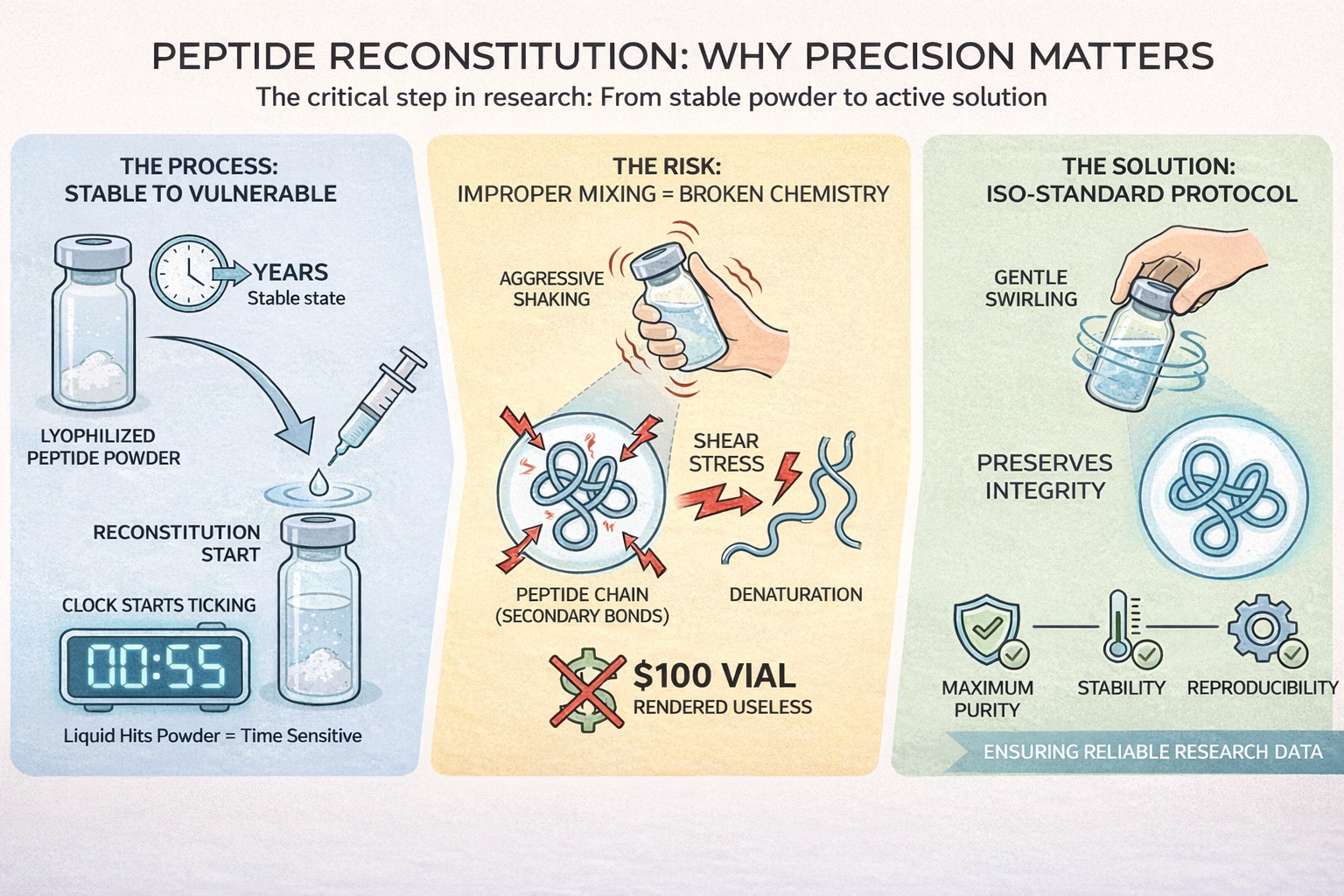
Reconstitution is the process of dissolving a lyophilized (freeze-dried) peptide using a sterile solvent for lab research applications.
Common Research-Grade Solvents
- Bacteriostatic water (often used for multi-use research samples)
- Sterile water for injection (single-use laboratory protocols)
- Sterile saline (when specified by research methodology)
Always follow your approved lab protocol when selecting solvents and volumes.
Reconstitution Best Practices
- Allow vials to reach room temperature before introducing solvent
- Add solvent slowly down the side of the vial
- Do not shake — gently swirl or roll if mixing is required
- Visually inspect for clarity and particulate matter
Improper mixing techniques can compromise peptide structure.
Storage & Stability Considerations
Correct storage is essential to maintaining peptide integrity.
Lyophilized (Dry) Peptides
- Store refrigerated or frozen as recommended
- Protect from light and moisture
- Keep vials sealed until use
Reconstituted Peptides
- Store according to protocol-defined temperature ranges
- Avoid repeated freeze-thaw cycles
- Consider aliquoting to reduce handling exposure
Stability varies by compound—always reference your research design.
Common Handling Errors to Avoid
- ❌ Using non-sterile tools or surfaces
- ❌ Shaking reconstituted solutions
- ❌ Touching sterile components
- ❌ Exposure to excessive heat, light, or air
- ❌ Inadequate labeling or documentation
Attention to detail is critical when working with precision-manufactured research materials.
Disposal & Regulatory Compliance
Dispose of all peptide materials and lab supplies in accordance with:
- Institutional lab safety procedures
- Local and regional chemical disposal regulations
- Applicable research facility guidelines
Never dispose of laboratory research materials in household waste streams.
Our Commitment at Helix Havoc Labs
Helix Havoc Labs is built on transparency, consistency, and responsibility.
We proudly deliver:
- Precision-manufactured peptides for lab research
- Third-party tested products with accessible Certificates of Analysis (COAs)
- Secure packaging designed to preserve product integrity
- Educational resources that support responsible research practices
Your research deserves materials handled with the same precision you bring to your work.
Are Helix Havoc Labs peptides sterile?
Products are supplied for lab research use. Sterile handling and preparation are the responsibility of the research facility and protocol.
Can reconstituted peptides be stored long-term?
Stability depends on the compound and storage conditions. Aliquoting is recommended to reduce degradation risk.
Why should peptides not be shaken?
Agitation can disrupt peptide chains, impacting molecular integrity and experimental consistency.
Where can I find product documentation?
All products are part of a rolling batch testing program. COAs are made available on the COA page as testing is completed, and some products may be pending results
Final Note
Responsible handling is essential to reliable research outcomes. When protocols are followed and materials are respected, data quality improves—and so does confidence in results.